
Guide · 8 min read
Facial Hair Removal: Which Method Fits?
There are several ways to remove facial hair. The right method depends mainly on how many hairs there are, how thick and dark they are, and the skin tone of the area being treated.
While laser and IPL work mainly on pigmented hair, and electrolysis can also be used on light or white hair, a single stubborn hair may be better handled with a different method than a large beard or upper-lip area.
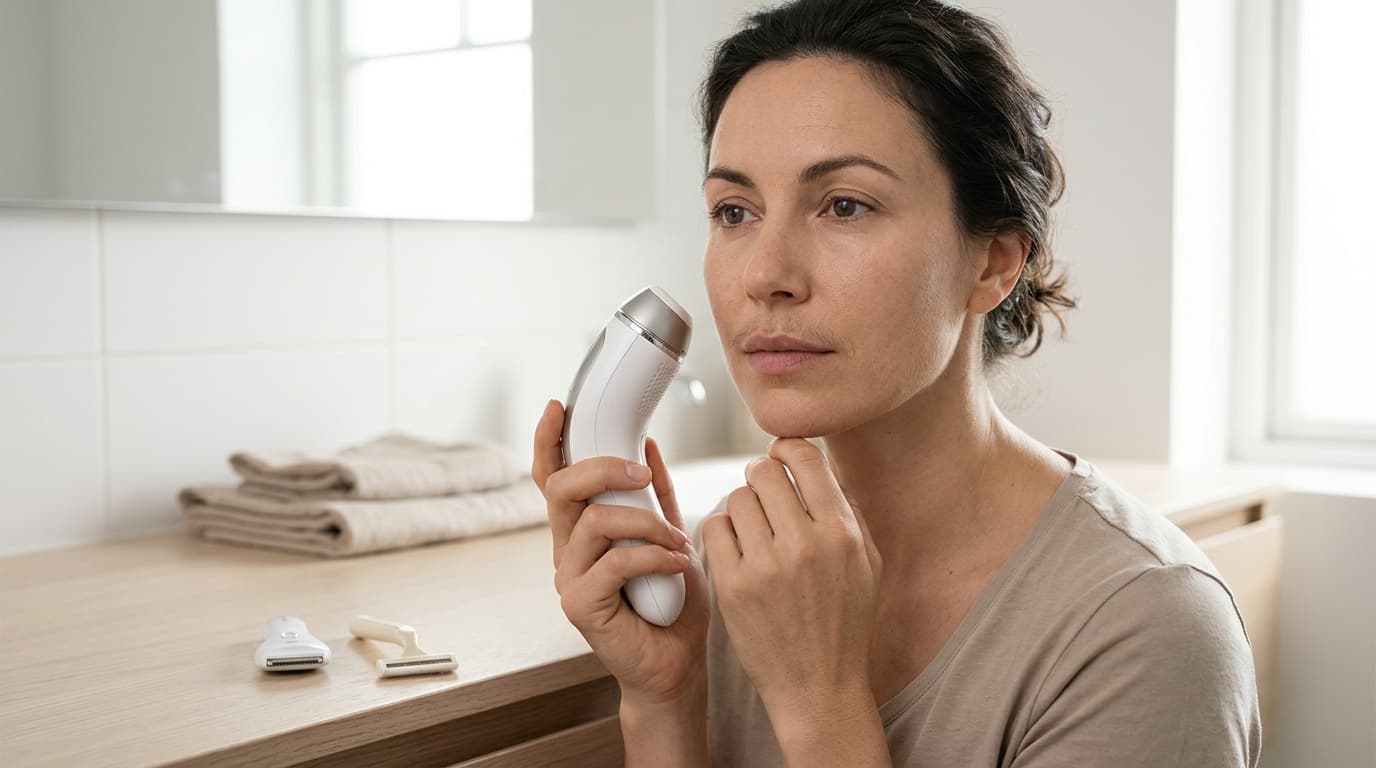
The main methods compared
| Method | Suitable for | Durability | Especially useful for |
|---|---|---|---|
| Shaving | All hair and skin types | Short | Quick, simple removal |
| Waxing / threading | Many hair colors | A few weeks | Short-term removal |
| IPL | Mainly dark hair with a suitable skin tone | Long-lasting reduction | Larger areas at home |
| Laser | Mainly dark, coarse hair | Long-lasting reduction | Larger facial areas |
| Electrolysis | All hair colors | Permanent removal of individual follicles | Individual or light hairs |
For laser and IPL, the contrast between hair pigment and skin is decisive. The Endocrine Society recommends photoepilation for dark or pigmented hair, and electrolysis for white or blonde hair.
IPL on the face
IPL stands for “intense pulsed light.” The device emits broad-spectrum light pulses, whose energy is absorbed in part by the melanin in the hair and converted into heat. This damages the hair follicle and reduces further growth.
The face calls for particular caution. Not every at-home IPL device may be used on every part of the face.
For example, Philips allows use of the Lumea 9900 on women below the cheekbones. Braun excludes the face, neck and jaw area for men. SmoothSkin also notes that the Pure Fit should not be used on men’s faces, jaws or necks. For a detailed device comparison, read our guide IPL Hair Removal Device Test & Comparison 2026.
In short, don’t assume an IPL device can be used on the face just because it is approved for hair removal in general. The instructions for the specific device are what count.
Laser hair removal on the face
Professional laser treatments are well researched, especially for dark, coarse hair. Commonly used lasers include alexandrite, diode and Nd:YAG.
In a randomized split-face study of women with PCOS, an alexandrite laser was more effective than IPL on the face. After six treatments, hair reduction on the laser side was about 46–52 percent, compared with about 21–27 percent on the IPL side during follow-up. The hair-free intervals were also longer with the laser.
A systematic review from 2024 likewise concluded that alexandrite lasers were more effective than IPL in the PCOS studies it analyzed.
This does not mean every laser works better than every IPL device. Device type, energy, skin type, hair thickness and treatment settings all play a decisive role. For possible side effects and long-term risks of laser hair removal, read our guide Laser Hair Removal Safety: Is It Harmful Long-Term?.
Electrolysis for individual facial hairs
Individual dark, blonde, red, gray or white facial hairs can be a good use case for electrolysis. A very fine probe is inserted into the hair follicle and the follicle is treated with electrical energy.
The big difference from IPL and laser is that the method does not depend on melanin in the hair, so it can be used regardless of hair color. The Endocrine Society explicitly names electrolysis as an option for white or blonde hair.
The drawback is time. Each hair or follicle must be treated individually. For hundreds or thousands of hairs, the method is considerably more time-consuming than a light-based treatment.
| Situation | Suitable options |
|---|---|
| Individual dark hairs on the chin | Electrolysis, or laser as an alternative |
| Individual white or gray hairs | Electrolysis |
| Dark hairs on the upper lip | IPL or professional laser, if suitable |
| Many dark facial and neck hairs | Professional laser can be a good option |
| Fine light peach fuzz | Shaving or other mechanical methods |
| Large area with dark hair | Laser or suitable IPL |
| Very dark skin tone | Choice of the right laser or a qualified practitioner is important |
With darker skin types, professional photoepilation often uses a longer-wavelength system such as Nd:YAG, because it places less stress on the skin’s melanin. The Endocrine Society also points to an increased risk of paradoxical hypertrichosis in certain groups, especially with facial treatments.
Can laser or IPL on the face cause more hair to grow?
A rare side effect of laser and IPL treatment is paradoxical hypertrichosis. In this case, hair growth in or near the treated area can appear stronger than before.
A systematic review and meta-analysis of 9,733 patients estimated a pooled frequency of about 3 percent. Outside the face and neck, the phenomenon was considerably rarer at 0.08 percent. The data come mainly from observational studies, so the exact frequency remains uncertain.
This is one reason why light treatment is not automatically the best choice for very fine facial hair.
Which method makes sense for a few hairs?
For a few individual hairs, a large laser or IPL treatment is often less worthwhile than for dense growth.
Individual light, gray or white hairs are a typical case for electrolysis. For a few coarse dark hairs, a targeted professional laser treatment can also be an option. If only a few hairs bother you, shaving remains the simplest method.
What about hormone-related hair growth?
If facial hair is increasing quickly or is unusually pronounced, a medical evaluation can be helpful. In hirsutism, guidelines may address underlying hormonal factors as well as the visible hair.
Hair removal alone does not change the cause of hormonally driven hair growth.
Bottom line
No single method suits everyone for facial hair removal.
Dark, coarse hair across larger areas often responds well to professional laser treatment. IPL can work too, but depends more on the device, skin and hair color, and the body areas it is approved for. Individual or very light hairs are a typical use case for electrolysis. For fine hairs, a mechanical method such as shaving may be more practical. To find the method that fits your own combination of hair and skin, try the HairFinder.
The choice of method mainly depends on hair color, hair density, skin type and the exact area of the face.
Sources
- Endocrine Society, Clinical Practice Guideline on hirsutism.
- Randomized split-face study comparing laser and IPL for facial hair in women with PCOS.
- Systematic review (2024) of alexandrite laser vs. IPL for PCOS-related facial hair.
- Desai et al., systematic review and meta-analysis on paradoxical hypertrichosis after laser and light therapy.